
Introduction

In the rapidly evolving landscape of optical communication, Large-Diameter Plastic Optical Fiber (POF) stands out as a promising alternative to traditional glass fiber optics. While glass fibers have long dominated high-speed data transmission, POF offers a compelling combination of flexibility, durability, and cost-effectiveness, making it particularly suitable for specific applications where glass might be impractical or too expensive.
POF technology has gained significant traction in areas such a home networking, automotive connectivity, and industrial sensing. Its unique properties make it an essential component in modern communication infrastructures that require robustness and ease of installation without compromising on performance.
This article delves into the technical aspects of large-diameter POF, its key advantages, and the growing range of applications that are benefiting from this innovative technology.
What is Large-Diameter Plastic Optical Fiber?
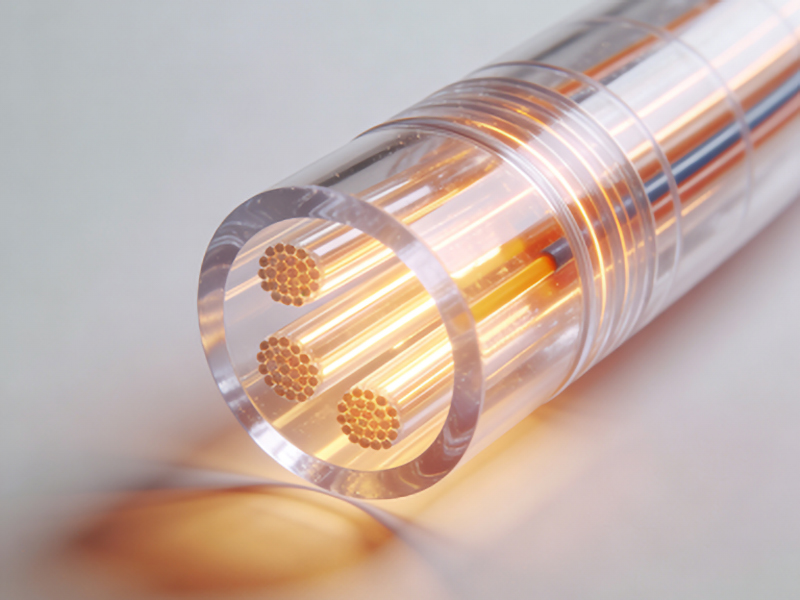
Plastic Optical Fiber (POF) refers to optical fibers made primarily from polymethyl methacrylate (PMMA) or other plastic materials, as opposed to the silica glass used in conventional fiber optics. The “large-diameter” aspect typically refers to fibers with core diameters ranging from 500 to 1000 micrometers, significantly larger than the 9 micrometers found in standard single-mode glass fibers.
This increased diameter offers several advantages:
* Easier Alignment: Larger cores make it simpler to align connectors and splices.
* Tolerance for Misalignment: POF can maintain signal integrity even with imperfect connections, which is crucial for cost-effective installations.
* Higher Numerical Aperture: This allows for easier coupling with light sources and photodetectors.
However, this also means that POF has higher signal loss (attenuation) compared to glass fibers. Typical attenuation for POF ranges from 50 to 100 decibels per kilometer, while single-mode glass fibers achieve less than 0.2 dB/km.
Technical Specifications
Key technical parameters for large-diameter POF include:
* Core Diameter: Usually 500 or 600 micrometers (μm), though variations exist.
* Cladding Diameter: Typically 480 or 500 μm for the outer layer.
* Numerical Aperture (NA): Generally higher than glass fibers, often around 0.2 to 0.3. This determines the light-gathering ability.
* Wavelength: POF is commonly used in the visible spectrum (around 650-850 nm) for short-distance applications.
* Bandwidth: While lower than glass fibers, modern POF can support data rates up to several gigabits per second (Gbps) over distances of hundreds of meters.
Advantages of Large-Diameter POF
1. Ease of Installation: The larger diameter and higher NA make stripping, cleaving, and splicing easier, even for unskilled personnel. This significantly reduces installation time and costs.
2. Durability: Plastic construction makes POF more resistant to bending, crushing, and environmental factors like temperature fluctuations and chemical exposure compared to fragile glass fibers.
3. Cost-Effectiveness: POF systems are generally less expensive to purchase and install than glass fiber systems.
4. Safety: POF is designed to be eye-safe (Class 1 or Class 2 according to laser safety standards) when used properly, eliminating the need for expensive safety equipment during installation.
5. Flexibility: POF can be routed through tight spaces and is less prone to breakage from minor impacts.
Limitations and Challenges
Despite its advantages, POF also faces certain limitations:
* Higher Attenuation: Signal loss is significantly higher than glass, restricting the maximum transmission distance.
* Lower Bandwidth: While sufficient for many short-range applications, POF cannot match the bandwidth capabilities of multi-mode glass fibers for long-distance, high-capacity transmission.
* Immunity to Electromagnetic Interference (EMI): Like all optical fibers, POF is immune to EMI, but this advantage is sometimes negated by the use of electrical components in POF systems (transceivers).
Applications
Large-diameter POF finds its niche in applications where the advantages of glass fibers are not essential or where the benefits of POF outweigh its limitations:
* Home and Building Networking: POF is widely used in Powerline Communication (PLC) systems, home entertainment networks (for distributing high-definition content to TVs and displays), and smart home applications.
* Automotive: Used in sensor networks within vehicles (e.g., tire pressure monitoring systems, body sensors) due to its durability and immunity to EMI.
* Industrial Sensing and Control: Ideal for short-distance communication in harsh environments.
* Educational and Medical Settings: Provides a cost-effective solution for networking within buildings.
* Short-Range Data Links: Replacing copper wires in various point-to-point connections.
Future Outlook
The future of large-diameter POF looks promising. Ongoing research focuses on reducing attenuation further and increasing bandwidth through improved materials and manufacturing processes. As data demands continue to grow, even in short-haul applications, POF offers a viable, cost-effective solution that complements rather than replaces glass fiber for longer distances.
The convergence of technologies, such as the integration of POF with Wi-Fi 6 and beyond, and the development of hybrid fiber systems (combining POF and glass fiber), will likely expand its application scope further.
Conclusion
Large-diameter Plastic Optical Fiber represents a valuable addition to the optical communication toolkit. Its unique balance of performance, cost, durability, and ease of installation makes it indispensable in specific segments of the market. While it may not match glass fiber in long-distance, high-bandwidth applications, its strengths shine brightly in scenarios requiring robust, cost-effective, and user-friendly data transmission solutions.
As technology continues to advance, POF will undoubtedly play an increasingly important role in connecting our homes, vehicles, and industrial environments efficiently and reliably.