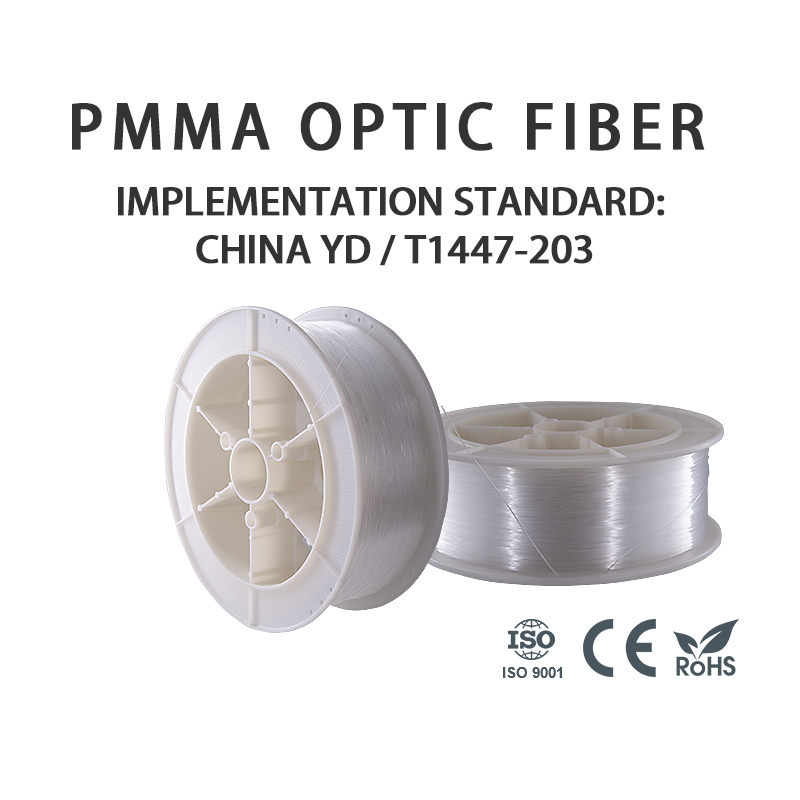

In the digital economy era, the iteration of information transmission media is the core of technological innovation. As a new type of material following quartz optical fiber, Plastic Optical Fiber (POF) is moving from professional fields to mass applications relying on its material and cost advantages, showing significant potential in scenarios such as smart homes and automotive electronics. This article analyzes its core competitiveness and application prospects.
Core Advantages: Breaking the Limitations of Traditional Transmission Media
Compared with quartz optical fiber and copper cable, POF has formed differentiated advantages in multiple dimensions such as material, processing and application, establishing its irreplaceability in specific scenarios.
Cost Advantage: Full-chain Cost Reduction and Efficiency Improvement
Cost advantage is the core competitiveness of POF, which runs through the entire process. In terms of raw materials, it uses general polymer materials such as polymethyl methacrylate (PMMA), whose price is only 1/10 of that of quartz; in terms of processing, extrusion molding is adopted for mass production, and the efficiency is 3-5 times higher than that of quartz optical fiber, while the manufacturing cost per kilometer is reduced by more than 60%.
Mechanical Performance: Flexible Adaptation to Complex Scenarios
Quartz optical fiber is brittle and has poor impact resistance. Its bending radius is usually not less than 20 times the fiber diameter, and slight bending may cause breakage or sharp increase in transmission loss. However, POF has excellent flexibility, with a bending radius as small as 5 times the fiber diameter, and can even be folded 180° without affecting transmission performance. This “flexible characteristic” enables it to easily adapt to complex wiring environments.
Safety and Compatibility: Safe Adaptation to Multiple Scenarios
The insulating property of POF endows it with natural safety advantages: it is non-conductive, does not generate electromagnetic interference (EMI), and is not affected by external electromagnetic signals. In flammable and explosive environments such as chemical industry and mining, it can avoid safety hazards caused by line leakage or electromagnetic sparks; in scenarios with high requirements for electromagnetic environment such as medical equipment and precision instruments, it can ensure the stability of transmission signals.
Short-distance Transmission: Optimal Performance in 100-meter Scenarios
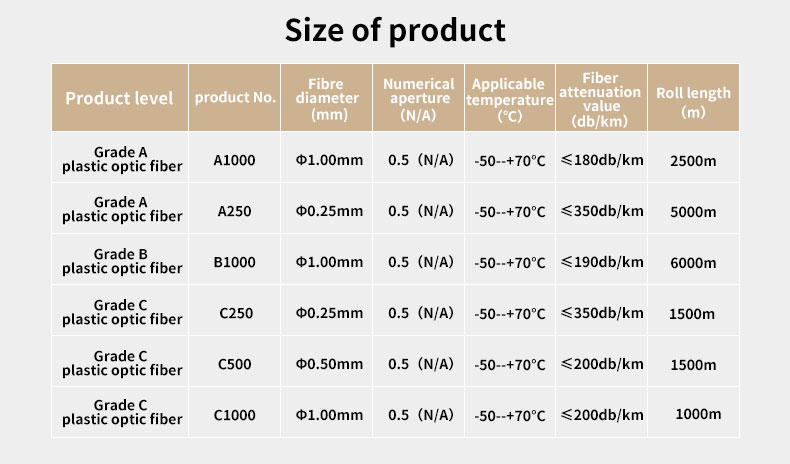
POF长距;+Although the transmission attenuation of POF (about 200dB/km) is higher than that of quartz optical fiber (0.2dB/km), which is not suitable for long-distance trunk transmission, its transmission rate can reach 1-10Gbps within 100 meters, which fully meets the needs of high-definition video and large data volume transmission. Compared with copper cables, POF has obvious bandwidth advantages – the bandwidth of a single POF can reach more than 1000MHz·km, which is 5-10 times that of Category 5 copper cables. It can easily carry large-bandwidth applications such as 4K/8K high-definition video and VR/AR real-time interaction, without signal attenuation and crosstalk problems of copper cables.
Application Prospects: Penetration from Vertical Fields to Mass Consumption
elying on the above core advantages, POF has gradually been applied on a large scale in fields such as smart homes, automotive electronics, industrial control, and consumer electronics. It is predicted that the market size will exceed 5 billion US dollars by 2028, becoming a core force in the short-distance optical transmission market.
Smart Home: Building a “Seamless Wiring” Ecosystem
In smart home scenarios, devices are scattered, wiring is complex, and cost-sensitive. The flexibility and low-cost characteristics of POF are just suitable for this demand. In home wiring, POF can be hidden in walls, floors or furniture gaps to realize high-speed connection between routers and terminals such as TVs, VR devices and smart speakers, supporting 4K high-definition video on demand and multi-device simultaneous online interaction.
Automotive Electronics: Empowering the “Nervous System” of Intelligent Connected Vehicles
With the acceleration of automobile intelligence and electrification, the number of on-board electronic devices has surged, and the requirements for transmission bandwidth and anti-interference have been greatly increased. POF has become an ideal choice for vehicle communication due to its advantages of anti-electromagnetic interference and strong flexibility: in the automatic driving system, it can connect sensors such as cameras, radars and lidars to realize real-time high-speed transmission of environmental data; in the in-vehicle entertainment system, it supports 4K video stream transmission on the rear display to improve passenger experience.
Industrial Control: Building a Reliable Transmission Foundation for the Internet of Things
In industrial scenarios, harsh environments such as high temperature, vibration and electromagnetic interference have high requirements on the reliability of transmission media. The impact resistance and anti-electromagnetic interference characteristics of POF enable it to work stably in scenarios such as intelligent manufacturing and chemical monitoring: in the interconnection of production line equipment, it can realize real-time communication between PLC (Programmable Logic Controller) and sensors/actuators with a transmission delay of less than 1ms; in chemical parks, using the insulation property of POF, a monitoring network in flammable and explosive areas can be built to realize safe transmission of data such as temperature and pressure.
Consumer Electronics and Medical Care: Unlocking Lightweight New Scenarios
In the field of consumer electronics, the lightweight advantage of POF makes it a new transmission material for VR/AR devices and wearable devices. For example, VR devices need to transmit high-definition video and posture sensing data at the same time. POF can realize multi-data channel transmission with a single cable, and its weight is only 1/5 of that of traditional copper cables, which improves the wearing comfort of the device.
Future Outlook: Technological Iteration Expands Application Boundaries
At present, the research and development of POF focuses on reducing transmission attenuation and improving high-temperature resistance: through doping modification technology, some enterprises have reduced the transmission attenuation of POF to below 50dB/km, expanding the transmission distance to 500 meters; high-temperature POF made of fluoroplastic can withstand high temperatures above 120°C, further expanding its application in extreme scenarios such as automobile engine compartments and industrial kilns.